
Castillo de San Marcos Visitor Tips From Just 7 Minutes Away
A local's guide to the Castillo de San Marcos: hours, ticket prices, parking, the best time to visit, cannon firings, and where to eat after.
The Castillo de San Marcos is the oldest masonry fort in the continental United States. It is also one of the most under-explained landmarks on the East Coast — the National Park Service signage is excellent inside, but most visitors arrive without the context that turns “old Spanish fort” into “the most consequential structure in 17th-century Florida.”
We live a seven-minute walk from the Castillo’s main gate, in Lincolnville, and we have been walking guests over to it for years. Below is what we tell them — Castillo de San Marcos visitor tips that we’ve refined through repetition, cross-checked with the rangers, and tested on grumpy nine-year-olds.
What you need to know in 60 seconds
- Open daily 9am to 5pm year-round (closed Christmas Day and Thanksgiving)
- Entry fee $15 per adult, valid for seven consecutive days; under 16 free
- No timed tickets — first-come, first-served
- Parking at the visitor lot is metered and fills by 10am in season
- Cannon firings four times a day on weekends (10:30am, 11:30am, 1:30pm, 2:30pm) and select weekdays in summer
If you do nothing else with this guide: arrive at 9am sharp, on foot or by Uber, and skip the parking entirely.
The best time to visit (specific, not generic)
Most “best time to visit” advice for landmarks is useless because it averages across seasons and miss the local rhythm. Here is what actually works at the Castillo:
9:00am, any day, October through April. The fort opens, the parking is empty, the sun has not yet baked the upper terreplein, and the trolley tour groups have not arrived. You will share the courtyard with twenty other early people and a few rangers setting up the day’s interpretive demonstrations. The first cannon firing of the weekend is at 10:30am, so you have ninety minutes of quiet exploration before the noise.
Avoid: weekends 11am to 3pm. Cruise-ship days (when a ship docks at Mayport, twenty miles north, and buses tourists to St. Augustine for the day) overload the courtyard. The line at the entry kiosk extends to the seawall.
Avoid: any afternoon June to September. The upper terreplein is open and unshaded. Florida summer afternoons cook the coquina to 110°F. Go in the morning or, if you must visit in the afternoon, do it after 4pm when the angle drops.
Best photography light: sunrise (the east side glows) and the hour before sunset (the west bastions catch warm light against the bay). The fort itself does not open until 9am, but the exterior grounds — including the Plaza de la Constitución view — are accessible 24 hours.
Parking, or how to skip parking
If you are staying outside the historic district, parking near the Castillo is the visit’s biggest source of pain. The fort’s own lot has roughly 60 spots and fills by 10am most days. The next-closest public lot (the historic downtown garage on Cordova Street) is a five-minute walk and charges $10 to $15 for the day depending on season.
The simple solution: if your hotel or rental is within twenty minutes’ walk, walk. If it is not, take Uber ($8-12 from anywhere on Anastasia Island) or use the free trolley shuttle that runs from the Visitors Information Center on Castillo Drive. Driving and parking is the worst of all options.
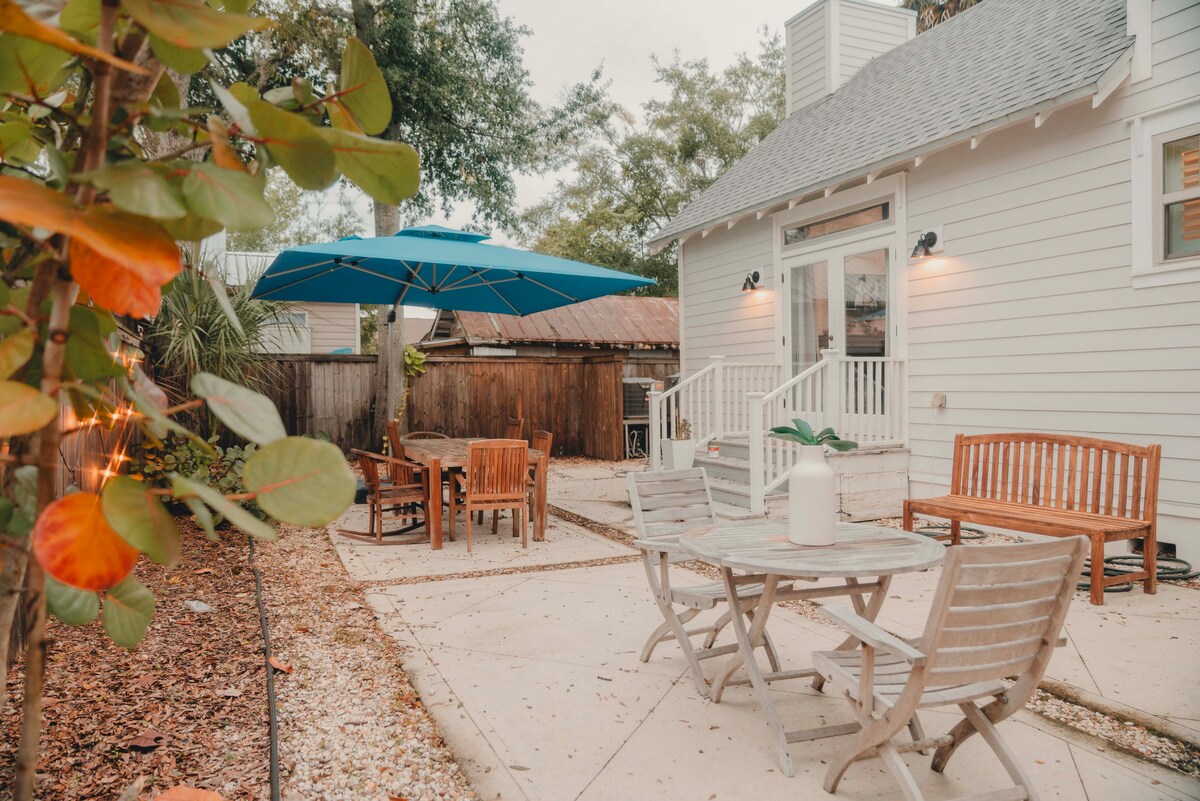
If you stay at Dinh Casa Historia in Lincolnville, the Castillo is an eight-minute walk on flat sidewalks and you never touch the parking question.
Tickets: what to actually buy
A standard adult ticket is $15 and is valid for seven consecutive days, which is the single best thing to know about Castillo tickets. Most visitors do the fort in ninety minutes, leave, and never come back — but the seven-day window means you can:
- Visit once for the cannon firing demonstration
- Come back later in the week for a quieter walk on the terreplein
- Bring different family members on different days using the same household ticket if you walk in together
Children under 16 are free with a paying adult. The America the Beautiful annual pass ($80) covers entry for everyone in your vehicle and pays for itself if you visit two or more national parks in a year.
There is no online ticket booking. The kiosk is fast — even on busy days the line moves in under fifteen minutes.
The cannon firing — worth waiting for
Volunteer interpreters in 17th-century Spanish military uniform fire one of the fort’s bronze cannons at scheduled times. They use blank powder charges (no ball), but the sound is concussive and the demonstration is precisely choreographed: command in Spanish, prime the touch hole, light the linstock, fire. The whole sequence takes about ten minutes, and the firing itself is over in a second.
Where to stand: the courtyard, not the upper terreplein. Up top you get a view but you also get the full muzzle blast. The ramparts above the cannon are roped off during firings for ear-safety reasons.
Bring ear protection if you are with small kids. The blast genuinely surprises children under five and we have seen tears.
The firing happens roughly four times a day on weekends and select weekdays in summer. The schedule is posted at the entry kiosk that morning — it changes with weather and ranger availability.
What to actually look at inside
The fort is small and dense, and you can speed-walk through it in twenty minutes. That is a mistake. Here is what is worth slowing down for:
The coquina walls themselves. Coquina is a natural sedimentary stone made of compressed shell fragments — the Spanish quarried it from Anastasia Island, two miles south. It is soft when freshly cut and hardens with exposure to air. Cannonballs fired against the coquina did not shatter the wall; they sank into it. There are still embedded English cannonballs from the 1702 siege visible in the eastern bastions. Find them.
The chapel. A small interior room, vaulted, used by the Spanish garrison for daily mass. The acoustics are remarkable — clap once and listen.
The dungeon. A narrow, low-ceilinged room used to hold prisoners — including, briefly, Osceola, the Seminole leader, in 1837. The temperature is noticeably cooler than the rest of the fort because the room is cut into the wall mass.
The terreplein view. From the upper deck you see Anastasia Island to the east, the Bridge of Lions to the south, and Lincolnville rooftops to the southwest. Best photo angle is from the southeast bastion.
The garita (sentry box) on the northeast corner. The single most photographed object at the fort, jutting out over the bay. Most photographers shoot it from the courtyard; the better angle is from the seawall outside.
Where to eat after
The Castillo is between Lincolnville to the south and St. George Street to the north — both have good food within ten minutes’ walk.
For something quick after a morning visit:
- Southern Charm Bake Shoppe (Lincolnville, 7-minute walk) — cinnamon rolls and cold brew on a residential porch
- Café del Hidalgo (Aviles Street, 4-minute walk) — empanadas and Cuban coffee, the most authentic on the corridor
For a sit-down lunch:
- The Floridian (Lincolnville, 6-minute walk) — Southern farm-to-table, dog-friendly patio
- Catch 27 (Lincolnville, 8-minute walk) — Florida-only seafood, the shrimp and grits is the order
For a beer:
- Bog Brewing (Lincolnville, 5-minute walk) — the neighborhood taproom
We avoid recommending St. George Street restaurants for post-Castillo lunch because the corridor is crowded with mediocre tourist-grade food. Walk the extra five minutes south into Lincolnville for measurably better options.
For a fuller list of what to do in the neighborhood, see our 17 things to do in Lincolnville guide.
A few common questions
How long should I plan for the fort? Ninety minutes is the right number for a thorough first visit. Two hours if you stay for a cannon firing.
Is it worth visiting with small kids? Yes — the courtyard is open and contained, the rangers are good with kids, and the cannon firing (with ear protection) is genuinely memorable. Strollers are fine on the courtyard but the terreplein has stairs only.
Wheelchair access? The courtyard, dungeon, chapel, and exhibits are accessible. The terreplein is not — only stairs. Park rangers can describe the upper deck experience for visitors who cannot reach it.
Are pets allowed? Service animals only inside the fort. Outside grounds are dog-friendly and most of our pet-owner guests walk their dog past the fort to the seawall as a daily route. See our pet-friendly guide for more on traveling to St. Augustine with dogs.
Is the night-time exterior view worth seeing? During Nights of Lights season (mid-November through January) the fort grounds are wrapped in white lights and the silhouette against the bayfront is the most photographed view of the holiday season in St. Augustine. Outside the lights season, the fort is unlit but the moonrise over the bay is striking on clear nights.
If you stay in Lincolnville, the Castillo becomes part of your daily walking pattern rather than a single-visit tourist stop. Most of our guests walk past the fort grounds two or three times during a typical stay — once for the morning visit, once for the seawall walk to dinner, once for sunset photos. That is the right rhythm for a 17th-century fort that has been standing for 350 years.
Dinh Casa Historia — the Lincolnville farmhouse behind this guide
Three bedrooms, two baths, fenced yard, eight minutes on foot to Castillo de San Marcos. Booking direct saves 15-20% versus Airbnb on the same calendar.
Check availabilityMore from the local guide
12 Best Restaurants Near St. George Street (2026 Local Picks)
12 restaurants near St. George Street worth your dinner reservation, ranked by a local host. From Spanish tapas to Florida seafood.
Perfect St. Augustine 3 Day Itinerary (2026 Local's Plan)
A 3-day St. Augustine itinerary written by a local host: Castillo, St. George Street, beaches, distillery, where to eat & where to skip.

Ultimate St. Augustine Travel Guide 2026 (From a Local Host)
A local host's complete St. Augustine travel guide for 2026: where to stay, eat, walk, and what to skip — from a Lincolnville porch.
Reserve your St. Augustine stay
Same calendar Airbnb shows, lower fees on direct bookings. Florida tourism tax (11.5%) included in the total.
The direct booking calendar will appear here.
Once Hospitable is connected, guests will see real-time availability and pricing right in this spot — same calendar as Airbnb, lower fees. While we finish setting it up, please book through Airbnb.